Utility energy audit vs. independent assessment in Florida: which should you choose? Choose your serving utility’s audit when you need the utility’s own usage context, want to understand its current efficiency program, or must complete that program’s stated first step. Choose a qualified independent on-site assessment when the decision depends on property-specific observations, measurements or diagnosis that the utility scope does not expressly include. Use both in sequence when the utility review identifies an unresolved comfort, humidity or high-use question: the utility program can establish its account and program context, while the independent scope can collect the missing field evidence. Florida utility offerings differ, so compare eligibility, delivery method, tests and deliverables in writing rather than assuming the word “audit” means the same service everywhere. The current Florida Public Service Commission standards for Duke Energy Florida’s Home Energy Check illustrate several audit formats, while the U.S. Department of Energy’s assessment guide describes a professional assessment as a more detailed, equipment-based review.
The practical difference is who defines the scope
“Utility audit” identifies the program sponsor, not a universal test protocol. “Independent assessment” identifies a separately hired provider, but it still does not guarantee a particular inspection, instrument or report. The written scope controls in both cases.
| Decision point | Utility energy audit | Independent assessment |
|---|---|---|
| Access | Limited to the serving utility’s current customer and program rules | Contracted separately with a provider the property owner selects |
| Starting evidence | Often begins with the utility account, consumption history and program questionnaire | Begins with the owner’s decision, property history, symptoms and agreed access |
| Delivery | May be online, phone-assisted, walk-through or another program-defined format | Usually field-based when direct observations or measurements are required |
| Tests | Only the inspections and tests the utility program expressly lists | Only the inspections and tests included in the engagement; blower-door, infrared or duct testing is not automatic |
| Deliverable | Program-specific tips, analysis, report or next-step requirements | A negotiated report of observations, measurements, limitations and recommendations |
| Best fit | Understanding utility usage and navigating the utility’s own offering | Investigating a property question that needs documented field evidence |
This is not a quality ranking. A well-matched utility audit may answer the question completely, and a vaguely scoped independent visit may not. The useful comparison is evidence versus decision: what will the assessor observe or measure, what will the report state, and is that enough for the choice you must make?
What a utility audit can—and cannot—establish
Current Florida programs show why the format must be checked directly. Duke Energy Florida’s PSC-filed standards describe walk-through, online, phone-assisted and home-energy-rating audit types within one Home Energy Check program. Tampa Electric’s current residential Energy Audit page separately presents a personalized online audit and scheduling for an in-home audit. These are specific utility programs, not a statewide promise about price, eligibility, availability, tests or deliverables.
Use the utility program for utility-program questions
A utility audit is a logical first stop when you want to:
- review consumption information held by the serving utility;
- understand the audit options that utility currently makes available;
- learn whether a named utility program requires an audit before another step; or
- obtain the tips, report or program pathway the published utility scope describes.
Before relying on it, confirm the service account is eligible, whether the audit is online, by phone or on site, which areas and systems are reviewed, whether any measurements are taken, what written output you receive, and how long that output remains usable for the program. Keep the current program page or confirmation with the report because requirements can change.
Do not convert a screening result into a field diagnosis
Consumption history and a questionnaire can identify a pattern or help frame a question, but they cannot directly verify an air leak, duct leakage, surface-temperature pattern, ventilation condition or equipment condition inside the property. Even an in-home utility visit should be treated according to its stated scope. If the visit does not include a named test and recorded result, do not infer that the condition was measured.
The same limit applies to savings language. A program estimate or recommendation is an input to planning, not a promised result for the property. Record the data period, assumptions and date so a later assessor or contractor can tell what was observed and what was modeled.
When an independent field assessment adds needed evidence
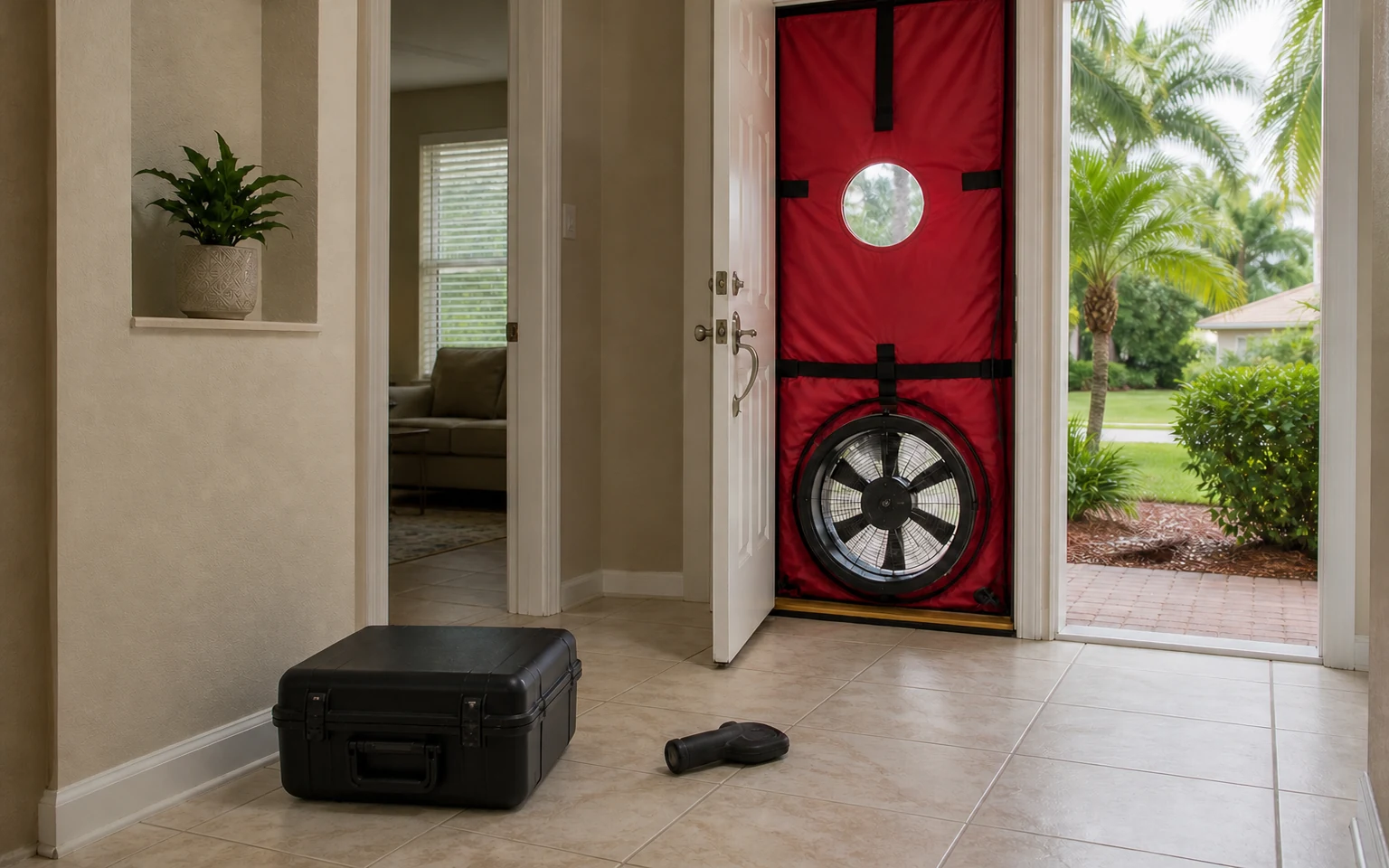
The DOE describes a professional home energy assessment as more detailed and equipment-based than a homeowner review. Its guide identifies a calibrated blower door and infrared scan as common techniques and notes that duct testing, gas-leak checks or ventilation checks may be used during an assessment. ENERGY STAR’s current Home Performance Assessment outline includes a homeowner interview, available bill history, visual evaluation of the exterior, interior, envelope and mechanical systems, appropriate safety and diagnostic testing, and prioritized recommendations.
Those sources describe a professional process; they do not make every test mandatory for every visit. An independent assessment earns its value when the engagement converts the property’s question into an explicit field scope.
Questions that usually require direct field evidence
Consider a separately scoped on-site assessment when the decision depends on facts such as:
- where air is entering or leaving the building enclosure;
- whether accessible ductwork is leaking and how the selected method measures it;
- whether surface-temperature patterns support further investigation of an envelope concern;
- how accessible HVAC, water-heating, ventilation and envelope components interact; or
- which observation or measurement supports each recommended next step.
An energy assessor is not automatically the right professional for every condition. Ask the assessor to identify the limits of the energy scope and the trade or specialist needed for electrical, structural, HVAC-repair, moisture-remediation or other diagnosis outside that scope.
Define the independent engagement before scheduling
Ask for a proposal that states:
- the decision question and accessible areas to be reviewed;
- the specific visual checks and diagnostic tests included;
- the measurement, photographs or other evidence that will appear in the report;
- the assessor’s relevant credential and who will perform each test;
- safety conditions, preparation steps and circumstances that could limit a test;
- exclusions, inaccessible areas and referrals that may be necessary; and
- how findings, assumptions, scenarios and recommendations will be separated.
DOE advises using a certified energy assessor. Verify the credential against the actual scope rather than treating any single title as proof that every diagnostic service is included.
A decision sequence that preserves both kinds of evidence
1. Identify the serving utility and the exact current offering
Use the name on the service account, then read that utility’s own audit page or current program documents. Do not substitute a neighboring utility’s program, a statewide summary or an old incentive list.
2. Write the decision before choosing the audit
“Why is usage high?” is a starting concern, not yet a testable scope. Add the relevant rooms, seasons, equipment changes, comfort or humidity symptoms, project timing and the decision ahead. BetterPowered’s energy advisory services can organize those property-wide dependencies, while the energy-audit planning page explains where online preparation ends and qualified field work begins.
3. Compare the written scopes line by line
Check the delivery method, accessible areas, tests, reported measurements, limitations and next-step requirements. If the utility audit already answers the decision with adequate evidence, avoid duplicating it. If it does not, give the independent assessor the utility output and commission only the missing scope.
4. Keep measured findings separate from planning scenarios
Store utility records, field observations and measured results as evidence. Store projected energy use, cost or savings as dated scenarios with visible inputs and assumptions. BetterPowered’s illustrative upgrade-scenario methodology shows how to preserve that distinction without turning an estimate into a guarantee.
5. Use the report to define the next qualified handoff
A report should make clear which issue is resolved, which remains uncertain and which professional owns the next step. If you request a referral after preliminary planning, review the BetterPowered Contractor Standard; matching remains conditional on trade, county, scope and availability, and you may choose your own qualified professional.
Where BetterPowered fits
BetterPowered currently offers a free online preliminary property plan. It can organize utility history, known property conditions, project dependencies, questions for an assessor and the evidence still needed. It does not sell or provide a standard paid whole-home assessment, on-site field diagnosis, measurement or certification, and it does not guarantee savings or project outcomes.
That makes BetterPowered a planning layer, not a substitute for either option in this comparison. Start with the free plan if the question is still broad, use the serving utility’s current audit for utility-specific context, and commission a qualified independent field scope when the decision requires observations or measurements the utility program does not provide.
Use this answer in a whole-property plan
Connect this topic to the planning hub, the primary decision page and the evidence standard that governs the next step.
- Planning hubEnergy advisory services
- Primary decision pageHome energy audit planning
- Methodology and standardsHow BetterPowered uses illustrative scenarios
- Methodology and standardsBetterPowered Contractor Standard
Sources
Sources used for the comparisons and explanations in this article.
- 01 Duke Energy Florida 2025 Program Participation Standards — Home Energy Check ProgramFlorida Public Service Commission · August 28, 2026
- 02 Energy AuditTampa Electric · August 28, 2026
- 03 Consumer Guide to Home Energy AssessmentsU.S. Department of Energy · August 28, 2026
- 04 Home Performance AssessmentENERGY STAR, U.S. Environmental Protection Agency · August 28, 2026
- 05 Home Energy Audit Planning in FloridaBetterPowered · August 28, 2026