Solar planning starts with the surface that carries it
Panel count is not the first roof question. Begin with age, material, visible condition, leaks, prior repairs, remaining service life and available permit history. A roofing professional or structural professional should evaluate conditions outside a solar installer’s scope when needed.
The U.S. Department of Energy advises homeowners to consider roof age and how long remains before replacement. Its consumer solar guide also notes that coordinating solar with a roof replacement can avoid duplicated work. The exact choice depends on the roof, contract and schedule, but the dependency should be resolved before financing is final.
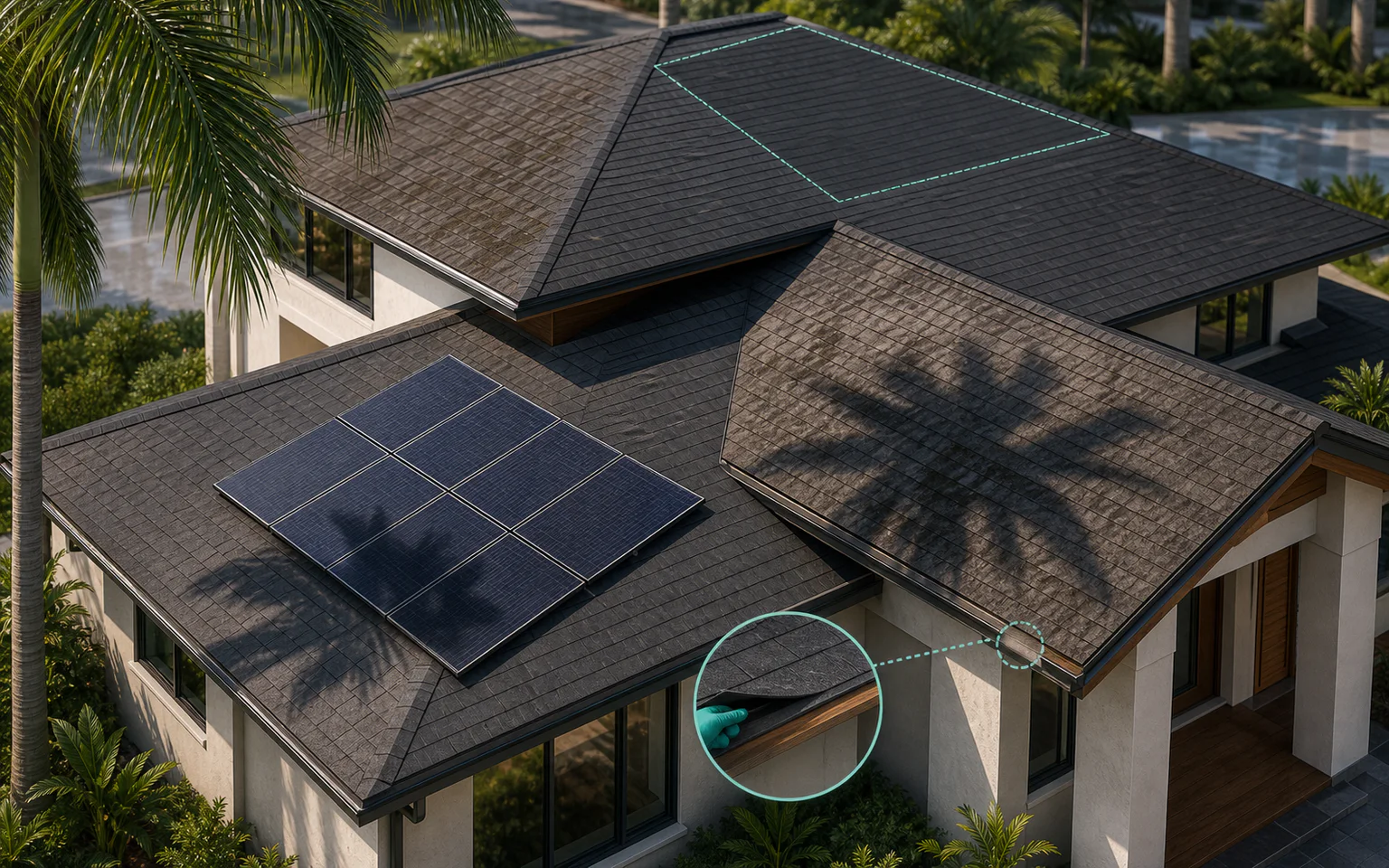
Map usable roof area, not total area
Chimneys, plumbing vents, mechanical equipment, ridges, hips, valleys, setbacks, access paths and shaded zones reduce usable area. Complex roof geometry can leave triangular or narrow regions that are unsuitable for standard modules. A preliminary remote layout is helpful, but field measurements and permit-ready design remain necessary.
Orientation and shade affect production. Roof pitch and local wind requirements affect racking and attachment. Structural capacity and roof condition affect whether installation can proceed. These are connected design inputs, not separate surprises for installation day.
Compare roof timing with solar timing
If the roof is near replacement, ask for three scenarios:
- roof work now and solar afterward;
- coordinated roof and solar work under clearly separated scopes; and
- solar now with the future removal-and-reinstallation obligation priced and assigned.
Do not assume a solar tax credit pays for ordinary roofing. The IRS currently explains that traditional components serving a roofing or structural function generally are not qualified clean-energy property. More importantly for 2026 planning, the IRS states that the federal residential clean-energy credit is not available for new property placed in service after December 31, 2025. Any prior-year eligibility or carryforward question belongs with a qualified tax professional.
Size from future electricity needs
After usable roof area is known, compare it with a realistic load forecast. Start with twelve months of electricity use and adjust for confirmed efficiency work, HVAC changes, EV charging, water heating, additions or occupancy changes. A system sized to the old load can be wrong in either direction.
Production estimates should state module assumptions, orientation, shade, losses and weather data. Utility interconnection and compensation rules affect economics and may constrain system size. Request the annual estimate and monthly profile, not only a percentage-offset headline.
Make responsibilities explicit
Roof warranty, solar workmanship, penetrations, flashing, removal and reinstallation can involve different companies. The contracts should identify who approves attachment details, who responds to a leak, how warranties interact and what happens if hidden roof damage appears.
Preserve photos, roof and solar plans, permits, equipment records and shutdown instructions. If the array is paired with storage, document which equipment must remain accessible and how emergency responders or service technicians isolate the system.
A better sequence avoids paying twice
Solar can be a valuable property upgrade, but it should not freeze an unresolved roof underneath it. Confirm the roof, define the future load, then design the array that fits both. That sequence protects the roof decision and produces a more credible solar proposal.
Use this answer in a whole-property plan
Connect this topic to the planning hub, the primary decision page and the evidence standard that governs the next step.
- Planning hubWhole-home upgrade planning
- Primary decision pageEnergy advisory services
- Methodology and standardsHow BetterPowered uses illustrative scenarios
- Methodology and standardsBetterPowered Contractor Standard
Primary sources
Claims in this article were reviewed against these government and primary sources.
- 01 Homeowner’s Guide to SolarU.S. Department of Energy · August 9, 2026
- 02 A Step-by-Step Guide for Consumers Going SolarU.S. Department of Energy · August 9, 2026
- 03 Residential Clean Energy CreditInternal Revenue Service · August 9, 2026