
Insulation and air leakage are different problems
Insulation slows heat flow through assemblies. Air sealing controls air moving through gaps and penetrations. A deep layer of attic insulation can still perform poorly where recessed lights, chases, attic hatches or wall tops allow uncontrolled air movement. Conversely, sealing without understanding moisture and ventilation can create a different set of problems.
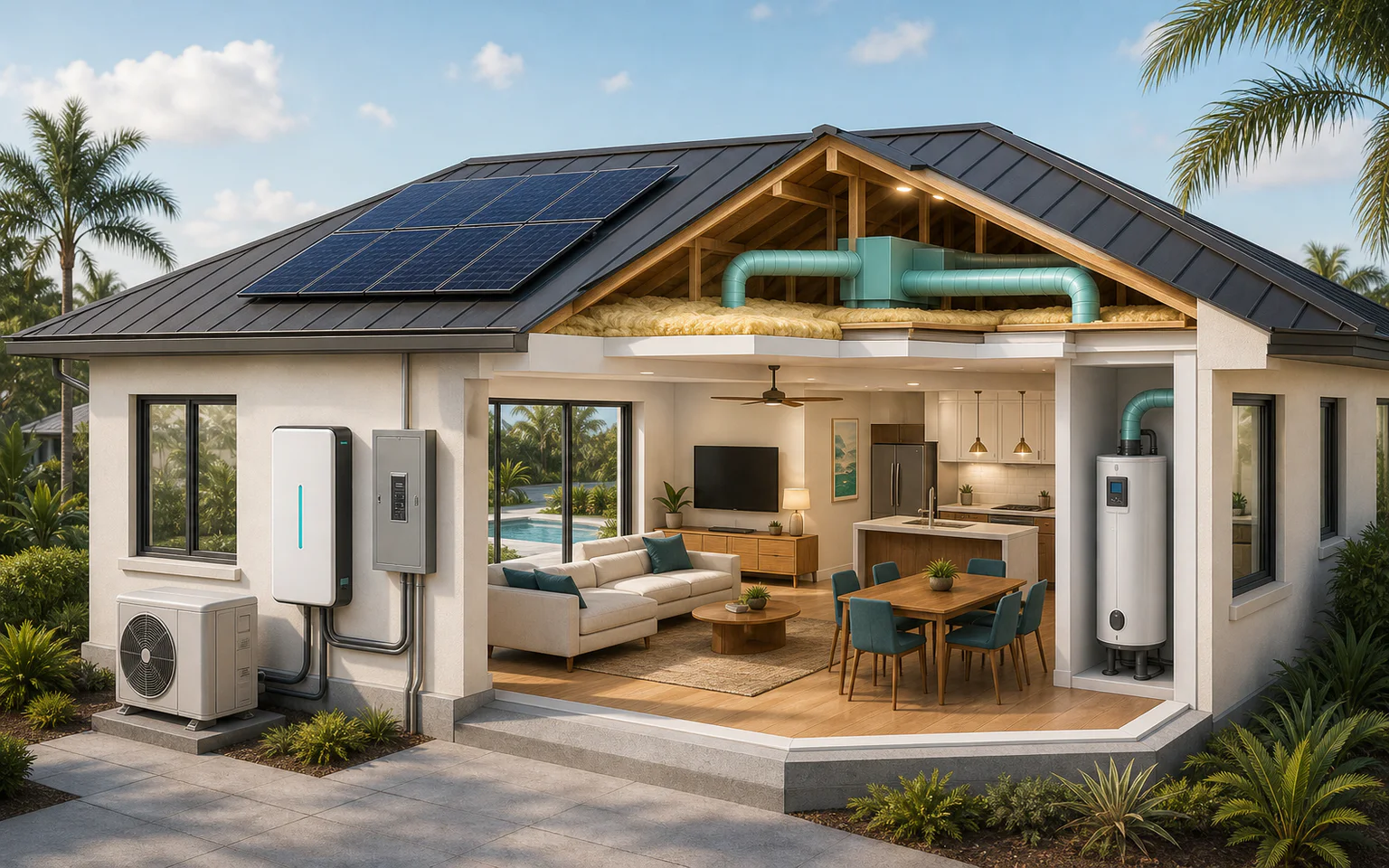
That is why a useful envelope plan identifies the pressure boundary, the thermal boundary and the ducts. Ideally they align around the conditioned space. When they do not, the project needs an explicit detail for the transition.
Diagnose before covering the evidence
An attic inspection can document insulation depth and coverage, compressed or disturbed areas, air paths, duct condition, signs of moisture and unsafe heat-producing equipment. Infrared imaging can reveal temperature patterns, but it should be interpreted with indoor-outdoor conditions and construction details. A calibrated blower door can quantify whole-house leakage and help locate important paths.
Complete air sealing before adding loose-fill insulation when practical. Once the area is covered, locating penetrations becomes harder and the new insulation may have to be disturbed. Combustion safety, clearances and local code requirements must be handled by qualified professionals.
Protect indoor air quality while tightening
The goal is controlled air, not zero air. The U.S. Environmental Protection Agency organizes indoor-air improvement around source control, adequate ventilation and filtration or air cleaning. EPA also advises controlling moisture and keeping indoor relative humidity below 60 percent, ideally within a lower comfort range when conditions allow.
An envelope project should therefore ask:
- Are there combustion appliances that need testing or dedicated air?
- How are bathrooms, kitchens and dryers exhausted?
- Is outdoor air intentionally provided and controlled?
- Can the HVAC system manage latent load and filtration at the selected airflow?
- Are there existing moisture sources that sealing could conceal?
These questions do not argue against air sealing. They define how to do it responsibly.
Coordinate ducts and HVAC
Leaky return ducts can draw attic or garage air into the system. Supply leaks can depressurize the home and push conditioned air outside. Poorly insulated or disconnected ducts can make some rooms hot even when the thermostat area feels comfortable. Repairing the envelope while leaving those paths untouched may produce an incomplete result.
Envelope changes can also alter the cooling load. If HVAC replacement is planned, give the load calculation the confirmed insulation and sealing scope rather than assuming the old house conditions will remain.
Verify the work
Good scopes describe materials and locations, not only a target R-value. They identify air-sealing details, insulation depth or assembly, duct treatment, ventilation impacts, protected clearances and photo documentation. When testing is part of the project, record pre- and post-work results using the same method.
Comfort and humidity should be followed after the work, especially through a representative hot and wet period. A lower leakage number is useful evidence, but the homeowner experiences room temperature, odors, moisture and air quality. Verification must connect the measurement to those outcomes.
Insulation, sealing, ventilation, filtration and HVAC are one indoor-environment system. Treating them together is how an efficiency project can improve comfort without trading away healthy air.
Use this answer in a whole-property plan
Connect this topic to the planning hub, the primary decision page and the evidence standard that governs the next step.
- Planning hubWhole-home upgrade planning
- Primary decision pageEnergy advisory services
- Methodology and standardsHow BetterPowered uses illustrative scenarios
- Methodology and standardsBetterPowered Contractor Standard
Primary sources
Claims in this article were reviewed against these government and primary sources.
- 01 Consumer Guide to Home Energy AssessmentsU.S. Department of Energy · August 9, 2026
- 02 Home Energy ImprovementsENERGY STAR · August 9, 2026
- 03 What can I do to improve indoor air quality in my home?U.S. Environmental Protection Agency · August 9, 2026