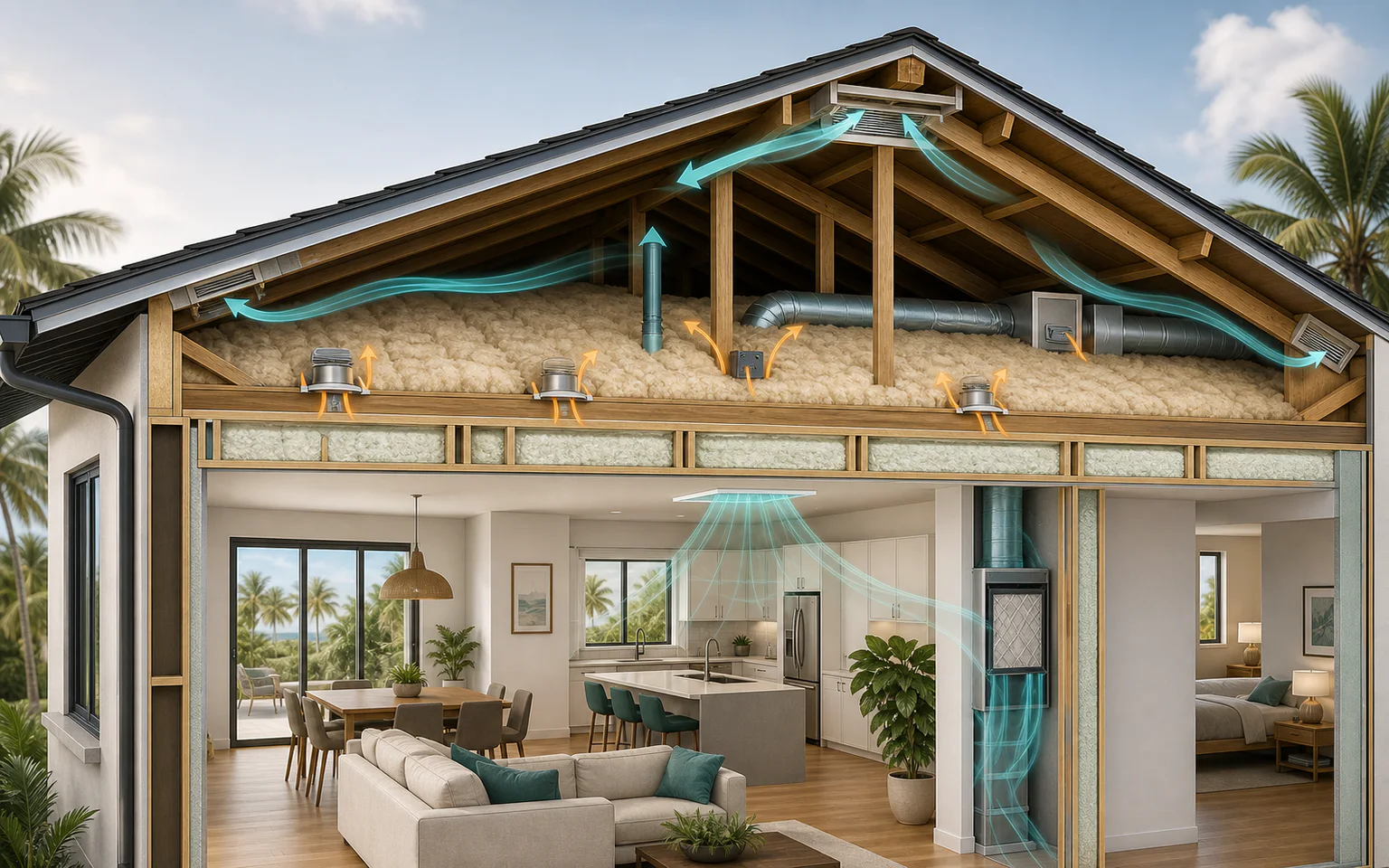

The outdoor unit is only one part of the system
A visibly modern condenser makes the replacement obvious, but performance depends on the indoor coil or air handler, refrigerant circuit, controls, duct system, airflow and the load created by the house. Replacing the outdoor unit without checking those relationships can preserve the same comfort and energy problems behind new equipment.
ENERGY STAR’s quality-installation guidance highlights four fundamentals: equipment sized from actual home characteristics, verified airflow, correct refrigerant charge and evaluated ducts. Those are installation requirements, not optional upgrades.
Ask how the load was calculated
Square footage alone is not a cooling-load calculation. Orientation, windows, roof and attic conditions, insulation, leakage, occupancy and internal gains all matter. A contractor should be able to explain the inputs used to select capacity and how planned envelope improvements were treated.
Oversized equipment can satisfy the thermostat quickly and cycle off before providing steady moisture removal. Undersized or poorly performing equipment may run continuously without meeting design conditions. Variable-capacity systems can operate across a range, but they still need a defensible design and correct commissioning.
Inspect ducts before connecting new equipment
Duct leakage, disconnected runs, crushed flex duct, restrictive returns and poor room-by-room distribution can reduce delivered performance. If ducts are in a hot attic, losses can be especially costly. The U.S. Department of Energy notes that leaks, holes and poor connections can lose a meaningful share of the air moving through a typical duct system.
Ask whether the proposal includes a visual inspection, leakage test when appropriate, static-pressure or airflow measurements and correction of known restrictions. A larger unit is not a substitute for delivering the designed air to each room.
Commission the installed system
The equipment label states what the product can do under specified conditions. Commissioning checks what this installation is actually doing. Useful records may include model and serial numbers, matched-system documentation, refrigerant-charge method, measured airflow or static pressure, temperature split, condensate drainage, thermostat configuration and start-up results.
In Florida, humidity control deserves explicit attention. Airflow and control settings affect sensible cooling and moisture removal. Comfort complaints should be described by room, time of day and humidity—not reduced to thermostat temperature alone.
Compare proposals by scope, not just efficiency rating
Two bids with the same nominal capacity and efficiency label may be very different projects. Compare what each contractor measured, which indoor and outdoor components are matched, what duct or electrical work is included, how permits are handled, what commissioning will be documented and which assumptions could change the price.
Also separate repairable distribution problems from equipment failure. In some homes, correcting ducts or airflow may improve comfort before replacement. In others, old or failed equipment makes replacement unavoidable, but the same duct work should be integrated into the scope.
Define success before installation
Write down the desired outcome: stable temperature in specific rooms, lower indoor humidity, reduced runtime, quieter operation or verified energy reduction. Capture a pre-project baseline when time allows. After installation, confirm operation under comparable conditions and retain the commissioning record.
The replacement should not be judged by how new it looks. It should be judged by whether the complete system was designed, installed and verified for this property.
Use this answer in a whole-property plan
Connect this topic to the planning hub, the primary decision page and the evidence standard that governs the next step.
- Planning hubWhole-home upgrade planning
- Primary decision pageEnergy advisory services
- Methodology and standardsHow BetterPowered uses illustrative scenarios
- Methodology and standardsBetterPowered Contractor Standard
Primary sources
Claims in this article were reviewed against these government and primary sources.
- 01 HVAC Quality InstallationENERGY STAR · August 11, 2026
- 02 Heat & Cool EfficientlyENERGY STAR · August 9, 2026
- 03 Home UpgradesU.S. Department of Energy · August 9, 2026