
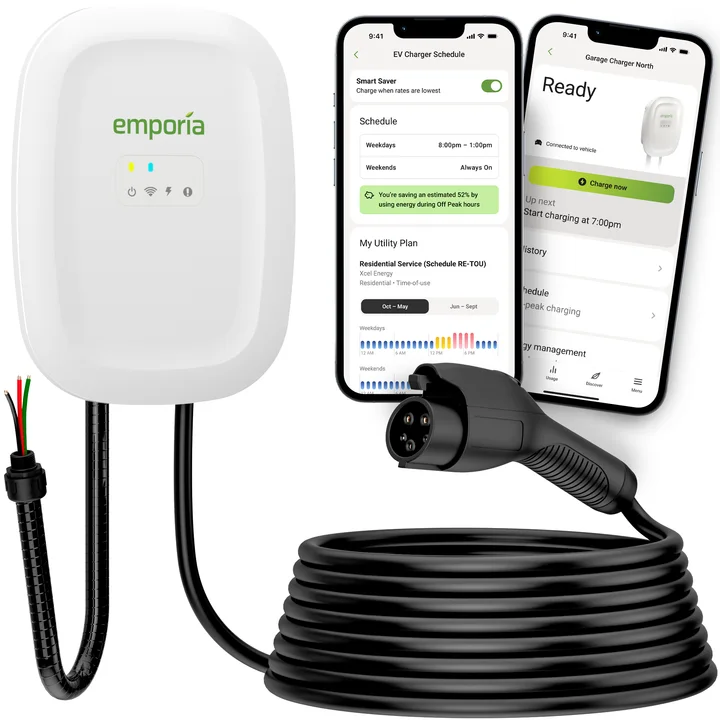
Home EV chargers
Choose a connector, a charging location and the right installation for your home.
2 models
No products found
Try another model name or explore all products.
How to choose a Level 2 home EV charger
A Level 2 charger runs on a 240 V circuit and charges much faster than a standard 120 V outlet. Choose the connector your vehicle uses: J1772, or NACS (SAE J3400).
The charger plugs into a NEMA 14-50 outlet or is hardwired. A charger is a continuous load, so the circuit is sized at 125% of the charging current: 40 A of charging needs a 50 A circuit, and 48 A needs a hardwired 60 A circuit. A licensed electrician should confirm panel capacity and pull any required permit.
- Your vehicle connector: J1772 or NACS.
- Plug-in (up to 40 A) or hardwired (up to 48 A on these chargers).
- Panel capacity for a new 240 V circuit.
- Cable reach from the mounting point to where you park (25 ft on these chargers).
- Indoor or outdoor mounting (these chargers have NEMA Type 4 enclosures).
Choose with more clarity.
What should I check before choosing an EV charger?
Check your vehicle connector, the available electrical circuit, the cable reach and whether the charger will be hardwired or use a NEMA 14-50 outlet. Have a qualified installer confirm the site. These chargers use a fixed grid connection; they must not be powered by a backup generator.
How are Classic and Pro different?
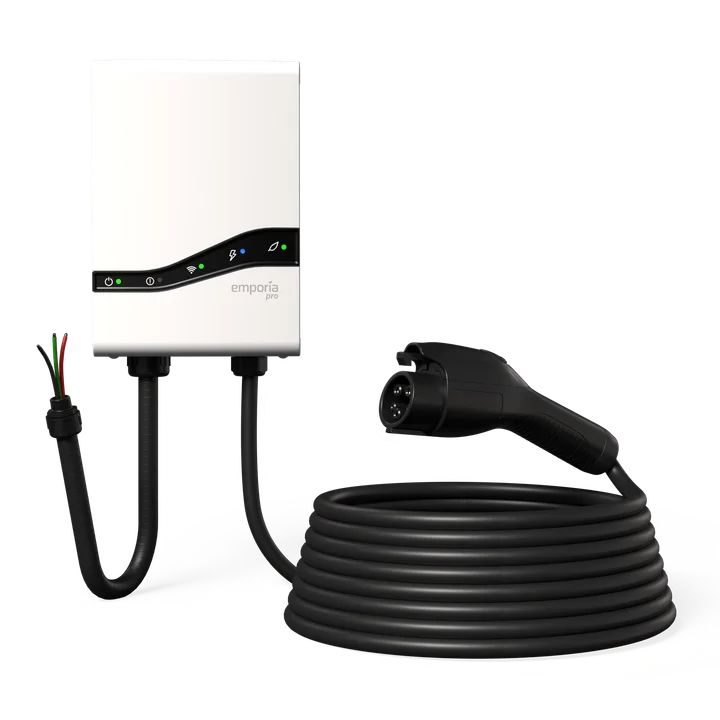
The Pro selection includes a Vue 3 monitor, two main-current sensors and PowerSmart. Classic does not include that monitoring kit or software. The Pro box does not include 8 or 16 branch-circuit sensors. Review the exact connector and installation variant on each page.
Plug-in or hardwired?
A plug-in charger uses a NEMA 14-50 outlet and charges at up to 40 A. A hardwired charger can charge at up to 48 A on a 60 A circuit. Both need a dedicated 240 V circuit installed by a licensed electrician.
J1772 or NACS?
Choose the connector your vehicle uses. NACS (SAE J3400) is used by Tesla vehicles and a growing number of other models; many other EVs use J1772. Check your vehicle maker’s guidance before relying on an adapter.
What does installation depend on?
Panel capacity, the distance from the panel to the charger, wire size and local permit rules. If the panel cannot take a new 240 V circuit, a load calculation shows the options before any upgrade.
Which battery do I need?
Choose what you want to keep on and for how many days. The calculator balances your usage hour by hour against the battery, the sun or a generator, at today’s prices.